
Microwave Repair – What Affects the Cost (by Fault)
Microwave repair costs explained by fault, from interlock switches and fuses to magnetrons and convection heaters, plus what makes the same repair cost more.
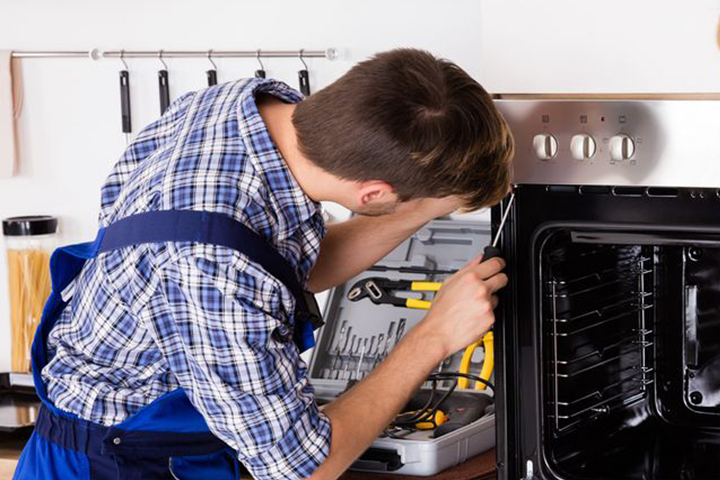
Quick answer: the cost of a microwave repair is set mainly by which part has failed, the type of oven (solo, grill or convection, countertop or built-in), how easy the part for your model is to get, and whether the fix can be done at your home or needs bench work. There is a visit charge for the inspection, parts and labour are quoted once the fault is identified, and the full price is agreed before any work starts.
Send a photo of the microwave and its model sticker. The price is agreed before any work starts.
How a microwave repair is priced
Every repair has the same structure. The technician inspects and tests the oven, which is what the visit charge covers. Once the failed part is identified, you are told what it is, whether it is original or compatible, and the full price for parts and labour. Nothing starts until you agree, and the old part is shown to you afterwards.
Our how we quote page explains this for every appliance we repair. This post goes through microwave faults one by one, because the fault is what decides where a bill lands.
Fault by fault: what drives the cost
| Symptom | Usual cause | What drives the cost |
|---|---|---|
| Display on, will not start | Door interlock switch or door latch | Which switch has failed, and whether the latch or hinge is damaged |
| Completely dead, display blank | Main fuse, often blown by a failed interlock; control board power supply | Finding why the fuse blew; board repair may need bench work |
| Runs but does not heat | High-voltage diode, capacitor, magnetron or transformer | Which part tests faulty; the magnetron is the costliest common part |
| Sparking inside | Burnt waveguide cover, food residue, damaged cavity paint | How long it was used while sparking, and whether the magnetron is affected |
| Turntable not turning | Coupler, turntable motor or roller ring | Usually at the lower end; motor or coupler for your model |
| Some keys not responding | Membrane keypad or control board | Whether a keypad for your model is available or the board is at fault |
| Grill or convection not heating | Heater element, convection fan, temperature sensor or relay | Which part, and convection parts are model-specific |
| Loud hum, buzz or grinding | Cooling fan, turntable motor, or a high-voltage fault | Mechanical noise is usually cheaper than an electrical buzz |
| Rusted cavity or damaged door | Wear, damage or long-term moisture | Usually replacement, not repair |
Things that move the price on any fault
- Type of oven. A solo oven is the simplest. Grill and convection models have extra heaters, fans and sensors. Built-in ovens take longer to remove and refit.
- Part availability for your model. Parts for widely sold current models are easier to get than parts for older or less common ones. A photo of the model sticker lets the technician check before the visit.
- Original or compatible part. Both are legitimate for many parts. You should be told which you are getting and why.
- At home or on the bench. Most faults are fixed at your home. Control board repair or a less common part may mean a second visit or taking the oven away, and you are told that first.
- More than one fault. A blown fuse is often a symptom. If the interlock switch that caused it is not replaced too, the new fuse blows again.
- How long the fault has been left. This is the big one for sparking, where continued use can damage the magnetron.
Safety first: never open a microwave’s outer casing, even unplugged. The high-voltage capacitor can hold a lethal charge long after the oven is switched off. If your oven sparks, smells of burning, or trips the MCB, unplug it at the socket and stop using it.
The cheaper faults are often the ones people ignore
A burnt waveguide cover and a worn interlock switch are among the cheaper repairs on a microwave. They become expensive when the oven keeps being used. Continued sparking works back towards the magnetron, and a failing interlock arrangement can keep blowing fuses or damage the board. Our guide on why a microwave stops heating explains the high-voltage side, where the more expensive faults sit.
When a repair is not worth it
Most single-part faults are worth repairing. The exceptions are a rusted-through cavity, a damaged door or hinge, a magnetron failure on a basic solo oven already well past its prime, and an oven where several unrelated parts are failing at once. A technician should tell you plainly when the repair does not make sense. Our guide to microwave repair or replacement goes through the decision.
How to avoid a bigger bill
- Stop using an oven the moment it sparks.
- Never run it empty in microwave mode. With nothing to absorb the energy, the magnetron takes it.
- Wipe splatter off the cavity and the waveguide cover while it is still slightly warm.
- Keep the vents clear. An oven pushed against a wall runs hot, and heat damages boards.
- During monsoon storms and long power cuts, switch the oven off at the socket. Voltage spikes when power returns can damage the control board.
Brand and model
Brand affects cost mainly through part availability and design. A convection model from LG or Samsung has more parts than a basic solo oven from the same maker. We are an independent repair service, not connected to any manufacturer. If your oven is still under warranty, contact the brand’s own service centre first, because independent work can affect that cover.
When to call a technician: for any fault in the table above. Start with a photo of the oven and its model sticker and a one-line description, such as “display on but will not start” or “runs but food stays cold”. The more precise the symptom, the more useful the first estimate. If your oven will not start at all, read microwave not starting or display blank first.
Frequently asked questions
How much does microwave repair cost in Kolkata?
It depends on which part has failed, the type of oven, part availability for your model and whether the work can be done at home. There is a visit charge for the inspection, parts and labour are quoted once the fault is identified, and the full price is agreed before any work starts. A photo of the model sticker helps you get a quick estimate.
Which microwave repair is the most expensive?
Among common repairs, a magnetron replacement or a control board fault usually costs the most. A rusted-through cavity or damaged door is not really a repair, because those parts keep the microwave energy inside the oven, so the oven is normally replaced. Door switches, fuses, couplers and waveguide covers are usually at the lower end.
Is it worth repairing a microwave that is not heating?
Often, yes. A no-heat fault can be a high-voltage diode, capacitor, transformer or the magnetron, and testing shows which. On convection, built-in and mid-range ovens a repair is usually worthwhile. On a basic solo oven with a failed magnetron that is already well past its prime, replacement may make more sense.
Why is there a visit charge for microwave repair?
It covers the technician's visit and the time spent testing the oven to find the actual fault. Without that diagnosis, nobody can tell whether a no-heat fault is an inexpensive diode or a magnetron. Once the fault is found, you are given the full price for parts and labour and decide before any work starts.
Do you repair grill and convection microwaves?
Yes. We repair solo, grill and convection microwaves across most common brands. Grill and convection models have extra heaters, fans and sensors, so there are more parts that can fail and the parts are more model-specific, which can affect the cost. Bench work such as control board repair may need a second visit or collection, and you are told before that happens.
Book a geyser or microwave repair
Tell us the appliance, brand and the problem, and we will arrange a technician visit in your area of Kolkata.
+91 82740 66348More repair guides

Racold vs Venus Geyser – Which Lasts Longer?
A fair look at Racold and Venus storage geysers: what each maker says about its tanks and warranties, and the three things that decide…

What Size Geyser Do You Need? (10, 15, 25 Litre)
10, 15 or 25 litres? How to size a geyser by how many people need hot water in the same hour, bucket or shower,…
Geyser Not Turning On? 7 Checks Before You Call
No light, no heat, no sign of life? Seven safe checks to rule out a switch, MCB, setting or supply problem before you book…